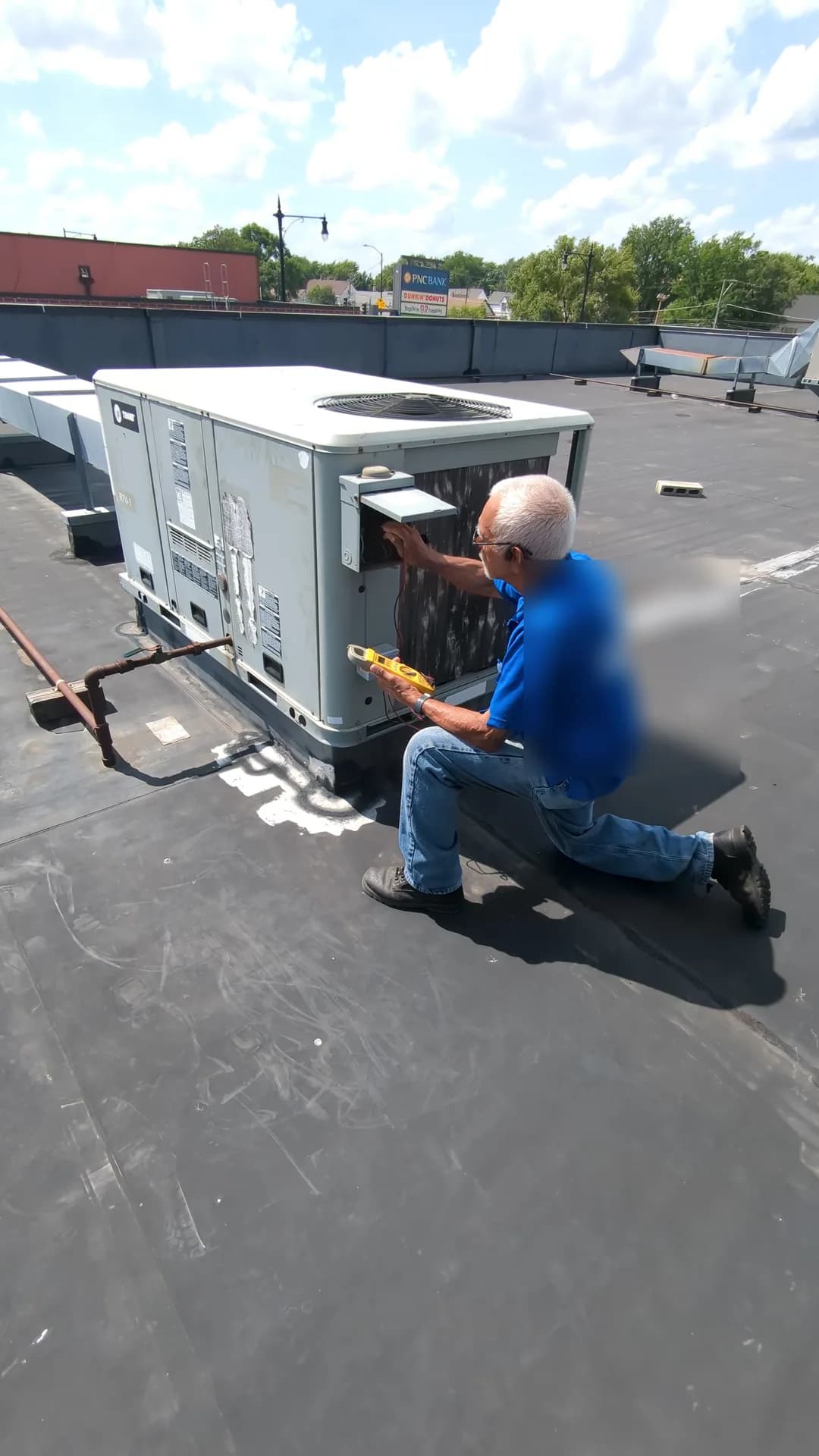
HVAC emergency in Chicago? Call Bernie's Heating & A/C Service now! Same-day service available for all heating and cooling emergencies.
For some musty basements, humidity testing shows that an affordable portable unit is a better fit than an expensive whole-home system.
Chicago basements are wet - clay soil, high water table, and summer humidity create perfect conditions for moisture problems. We've installed hundreds of basement dehumidifiers since 1992, and we'll tell you honestly whether you need a $ portable or a $$$ whole-home system.
If your basement smells musty or feels damp, your not alone. Chicago basements are wet by design - and it's getting worse with climate change. We see this in Jefferson Park, Albany Park, Irving Park, Norwood Park and every other northwest side neighborhood.
Chicago fact: Most Chicago basements run 60-70% humidity in summer without dehumidification. Mold starts growing above 60%. Target 40-50% for comfort and safety.
The honest answer - a $ portable dehumidifier works fine for most basements. You don't always need the $$$ whole-home solution. We'll tell you which one actually makes sense for your situation.
Capacity: 30-70 pints/day
Pros:
Cons:
Best for: Small basements (<800 sq ft), rental properties, testing before committing to whole-home
Capacity: 90-130 pints/day
Pros:
Cons:
Best for: Finished basements, whole-home humidity control, long-term solution, when you want it silent and automated
Our honest take: If your basement is unfinished and you're just trying to solve the musty smell, start with a $ portable. Run it for a summer. If it solves the problem, great—save yourself $$$. If you hate emptying the bucket and want it quieter, then upgrade to whole-home. We're not trying to sell you the expensive option if the cheap one works.
Get the wrong size and you'll either waste electricity or not fix the problem. Here's how to size it correctly.
Moderately damp (musty smell, some condensation)
30-50 pints/day
Typical: 50-pint portable ($$)
Moderately damp (musty smell, some condensation)
50-70 pints/day
Typical: 70-pint portable or 90-pint whole-home
Very damp (visible moisture, standing water)
90-130 pints/day
Typical: 130-pint whole-home ducted unit
Moderately Damp:
Very Damp:
If you're going with a whole-home unit, here's what installation involves. We're transparent about the work—no surprises.
We measure your space during the estimate and flag any install challenges BEFORE quoting. No "we didn't know it would be that hard" upcharges.
Here's what things actually cost. We include operating costs because electricity matters over 10 years.
10-Year Total Cost:
$ unit + $$ electricity = $$$
(Replace once at 6 years: +$)
10-Year Total Cost:
$$$ install + $$$ electricity = $$$
(Should last 10-15 years)
Factor operating cost into your decision: Portable units cost less upfront but require manual draining and may need replacement sooner. Whole-home units cost more upfront but are quieter and automatic. Choose based on your space, noise tolerance, and maintenance preference.
Dehumidifiers run a lot during Chicago summers. Here's what to expect on your electric bill.
Summer Season Cost (May-Sep, 150 days):
$
Summer Season Cost (May-Sep, 150 days):
$$
Energy costs based on: Chicago ComEd average rate of $/kWh. Your rate may vary. Newer Energy Star models use 20-30% less electricity than older units.
Both types need minimal maintenance. Here's what to expect.
Empty bucket daily
(or run drain hose to floor drain)
Clean filter monthly
$ cost, just rinse with water
Replace every 5-7 years
$$ for new unit
Clean filter quarterly
$ cost, rinse with water
Check drain annually
Ensure water flowing to floor drain
Replace every 10-15 years
$$$ for new unit + install
Dehumidifiers fix ambient humidity. They DON'T fix water intrusion. Fix the source first.
If water comes through your foundation walls or floor, you need foundation waterproofing—not a dehumidifier.
Cost to fix: $$$ (exterior drainage system)
If water pools next to your foundation, regrade your yard and extend downspouts away from the house.
Cost to fix: $$$ (grading + downspout extensions)
If your sump pump isn't working or you need one installed, that's step one. Dehumidifiers don't pump gallons of water.
Cost to fix: $$ (sump pump replacement/install)
If you have a slow leak from pipes or water heater, fix that before running a dehumidifier 24/7 to mask it.
Cost to fix: $$ (depends on leak location)
Bottom line: If you have standing water or active seepage, fix that FIRST. Dehumidifiers address ambient humidity (musty smell, condensation), not gallons of water. We'll tell you honestly if you need waterproofing instead of a dehumidifier.
Portable units cost $$ (DIY). Whole-home ducted dehumidifiers cost $$$ for 90-pint units or $$$ for 130-pint units. Add $ for a condensate pump if you don't have a floor drain, and $ for electrical work if needed. Factor in operating costs: $$ in electricty depending on unit size.
Portable units ($$) work fine for small basements under 800 sq ft or if your testing the concept. There loud and need bucket emptying, but there cheap. Whole-home units ($$$) are quieter, drain automaticaly, and better for finished basements or long-term solutions. Try a portable first if your unsure - you can always upgrade later.
A 70-pint portable running 10 hours/day costs about $ in electricty during Chicagos humid season (May-September). A 130-pint whole-home unit costs about $$. Over 10 years, a $ portable totals $$$ while a $$$ whole-home totals $$$. Factor operating costs into your purchase desicion.
Target 40-50% relative humidity in your basement. Above 60% encourages mold growth. Below 40% is unnecesarily dry and wastes electricty. Most whole-home dehumidifiers include a built-in humidistat for automatic control.
Yes, if you address ambient humidity. Dehumidifiers work great for musty smell and general dampness. But if you have standing water, active seepage, or foundation leaks, fix those FIRST. Dehumidifiers handle moisture in the air, not gallons of water comming through your walls.
In Chicago, you'll mainly run it May through September when outdoor humidity is high. Winter air is naturaly dry, so dehumidifiers typically aren't needed November-March. Leave it plugged in with automatic control - it'll only run when needed.
We'll asses your basement honestly - whether you need a $ portable or a $$$ whole-home system. Free consultation, no presure. We serve Portage Park, Jefferson Park, Albany Park, Irving Park, Norwood Park, Edison Park and all of Chicagoland.
Serving Chicago basements since 1992. We've seen every moisture problem—and we'll tell you the truth about what you need.