Call (773) 900-6248 to confirm current emergency service availability in your area and estimated technician arrival time.
AC refrigerant leak detection & recharge finds leaks and restores proper refrigerant levels for better cooling. But here's the truth: refrigerant doesn't "evaporate" - it circulates in a closed-loop system. If you're low, you have a leak. We find it, fix it, then recharge properly.
If your AC is running but not cooling, low refrigerant is one possible cause, but not the only one. We test capacitors, airflow, coil condition, and refrigerant readings before calling it a leak.
AC running but not cooling? Start hereAC refrigerant leak repair finds the leak location, fixes it, and recharges your system to proper levels. Refrigerant doesn't evaporate or get used up—it circulates in a closed loop. If your AC needs refrigerant added, there's a leak somewhere.
Most leaks happen in four locations: evaporator coils (40%), condenser coils (30%), service valves (20%), or line sets (10%). We use electronic leak detection, nitrogen pressure testing, UV dye, and bubble solution depending on leak size and location.
After repair, we vacuum test the system to verify the fix held, then recharge with the exact refrigerant amount specified by the manufacturer. If your R-22 system needs expensive leak repair and is 12+ years old, replacement makes more financial sense than continued repairs.
A refrigerant refill alone does not repair a leak. Here's how a recharge can leave the underlying problem unresolved:
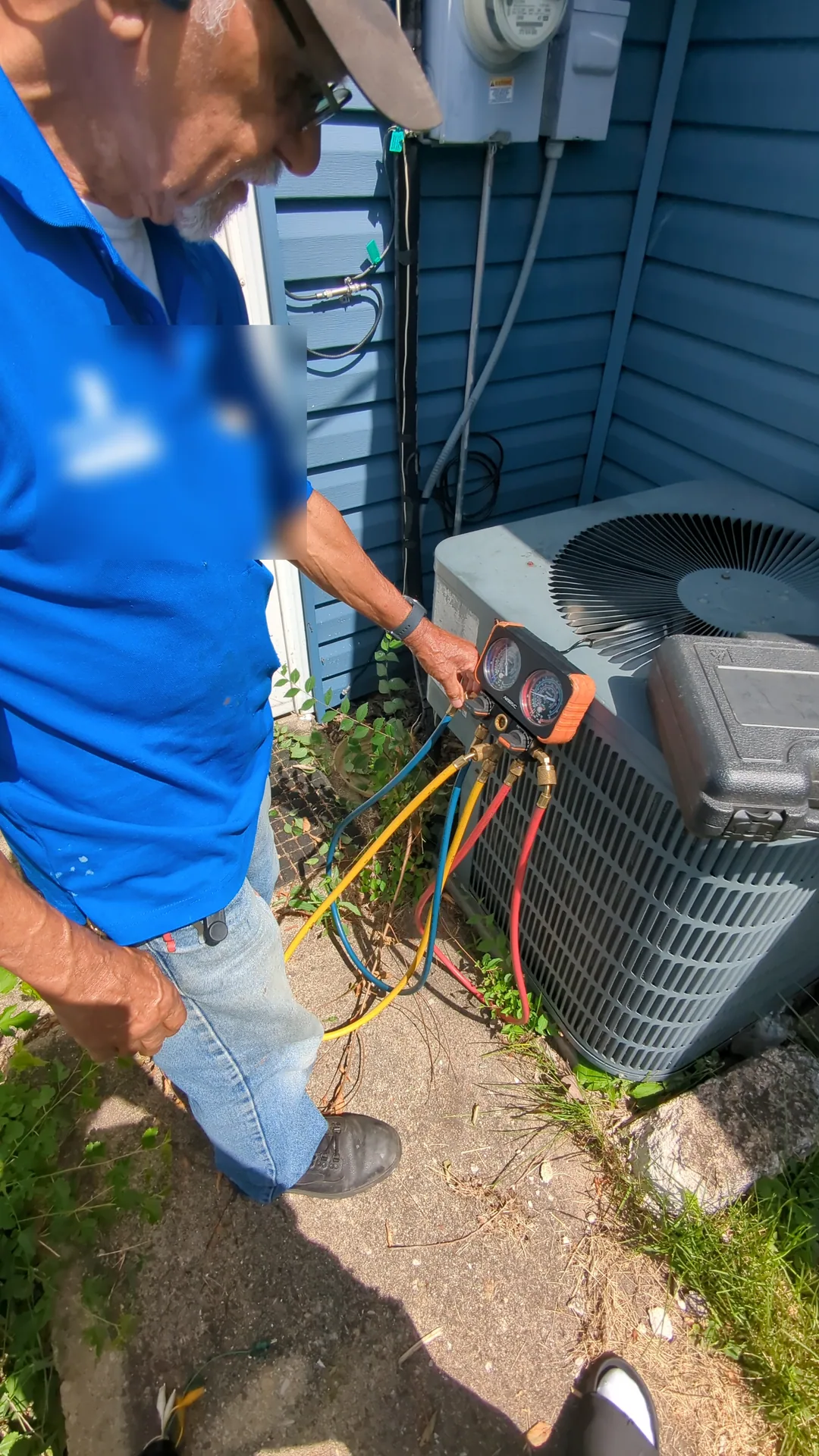
Your AC is blowing warm air. You call an HVAC company. Technician shows up, hooks up gauges, checks pressures.
They tell you the system needs a pound or two of refrigerant. They add refrigerant. AC blows cold again. They leave. You're happy.
AC is blowing warm again. You call the same company. Same technician. Same diagnosis. They add more refrigerant. Leave again.
You're now a repeat customer. You think refrigerant just "needs refilling" like gas in a car. The leak was never fixed because they never looked for it.
Refrigerant circulates in a sealed, closed-loop system. It doesn't get "used up" like gasoline. It doesn't evaporate. It doesn't burn off. It cycles between liquid and gas states continuously. A properly charged AC system should never need refrigerant added unless there's a leak.
If your refrigerant level is low, you have a leak. Period. End of discussion. The leak might be small - could take 6 weeks to lose enough refrigerant to affect cooling. Or it could be large - system goes down in days. But if you're low, there's a leak somewhere.
Any technician who adds refrigerant without finding and fixing the leak first is either incompetent or running a scam. And unfortunately, this scam is extremely profitable, which is why so many companies do it.
Finding refrigerant leaks requires different tools and techniques depending on leak size, location, and accessibility. We use all four methods:
Most common tool. Handheld sensor detects refrigerant molecules in the air. Can find leaks as small as 0.1 oz per year. We move the detector around all refrigerant connections, coils, and line sets.
Best for: Accessible connections, service valves, line sets
Detects: Small to medium leaks
Time: 15-30 minutes
We inject UV dye into the refrigerant system, run the AC for a few days, then use a UV light to find where dye has leaked out. Shows exact leak location with glowing dye stains.
Best for: Hidden leaks, evaporator coils, hard-to-reach areas
Detects: Slow leaks that are hard to find with electronic detector
Time: 3-7 days to circulate, then 15 minutes to inspect
Old-school but effective. We spray soapy water on suspected leak points. If there's a leak, the escaping refrigerant creates visible bubbles. Works great for larger leaks at connections.
Best for: Service valves, flare connections, brazed joints
Detects: Medium to large leaks
Time: 5-10 minutes for suspected areas
For major leaks or when we suspect a specific component. We recover all refrigerant, pressurize the system with nitrogen (up to 400 PSI), and monitor pressure for 15-30 minutes. Pressure drop = confirmed leak.
Best for: Verifying coil leaks, finding large leaks
Detects: All leak sizes, confirms leak location
Time: 30-60 minutes
We start with electronic leak detection (included in diagnostic fee). If we can't find the leak immediately, we recommend UV dye test. We don't charge for recharge until we've found and fixed the leak. This is the honest way to do business.
Refrigerant leaks can develop at several points in an AC system. Here are locations checked during diagnosis:
Indoor coil inside your furnace or air handler. Develops pinhole leaks from formaldehyde corrosion (from plywood offgassing) or from condensation sitting on the coil.
Location: Inside furnace/air handler (attic, basement, closet)
Detection: UV dye test usually required (coil hidden in enclosure)
Repair cost:
Decision: If AC is 12+ years old, replace whole system instead
Outdoor coil wrapped around the outdoor unit. Gets damaged by lawn mowers throwing rocks, hail, weed trimmers, corrosion from dog urine, or physical damage.
Location: Outdoor unit (yard, alley, rooftop)
Detection: Electronic leak detector, visible damage inspection
Repair cost: Contact us for a written estimate based on your system and the work required.
Prevention: Keep 2-foot clearance around outdoor unit
Connection points on the outdoor unit where technicians attach gauges. Valve cores can leak, valve stems can leak, or the connection itself can leak from over-tightening.
Location: Two valves on outdoor unit (suction and liquid lines)
Detection: Electronic detector or bubble test
Repair cost: Contact us for a written estimate based on your system and the work required.
Good news: Cheap and easy to fix
Copper refrigerant lines running between indoor and outdoor units. Leaks from poor brazing during installation, vibration damage, or physical damage (nails, drilling, remodeling).
Location: Between units (walls, attic, basement, exterior)
Detection: Electronic detector along accessible sections, UV dye for hidden
Repair cost: Contact us for a written estimate based on your system and the work required.
Often fixable: If lines are accessible
Your refrigerant type dramatically affects leak repair economics. Here's the situation as of 2020:
If your R-22 system has a leak that requires more than 2 lbs of refrigerant per year, replacement with a new R-410A system makes more financial sense than continued expensive recharges.
R-410A leak repairs are much more economical. Even coil replacement might make sense on newer R-410A systems because refrigerant is affordable and readily available.
Look at the data plate on your outdoor unit (the big metal box outside). It's usually on the side or back panel. The refrigerant type is clearly labeled:
If your outdoor unit was installed before 2010, it's almost certainly R-22. After 2010, it's R-410A.
Not all leak repairs make financial sense. Here are factors to discuss when comparing repair and replacement:
Always worth fixing. Quick, easy, cheap.
If lines are accessible, fix them.
On AC under 8 years old with R-410A refrigerant.
Consider replacement instead.
Usually not worth it.
Replace the whole AC system. Other components will fail soon.
Replace with new R-410A system. R-22 refrigerant will only get more expensive. Replacement saves money long-term.
If we find leaks in multiple locations (coil + service valve + line set), the system is deteriorating. Replace it before it fails completely during peak summer.
We'll tell you when a leak repair doesn't make financial sense. We make more money on repairs than on new AC sales, so if we recommend replacement, it's because it's genuinely the better value for you. We show you the math and let you decide.
Chicago has unique environmental factors that cause refrigerant leaks. Here's what we see constantly:
Chicago gets heavy thunderstorms with quarter-sized hail. Hail dents condenser coil fins and can puncture the thin aluminum coil tubing. You won't notice the leak immediately - takes weeks for refrigerant to escape through tiny punctures.
What to do: After major hailstorms, inspect your outdoor unit for dents. If AC stops cooling 2-4 weeks after a hailstorm, suspect coil damage. Check if homeowners insurance covers HVAC hail damage - many policies do.
If you live near Red, Brown, Green, Pink, Orange, or Purple Line elevated tracks, constant vibration loosens refrigerant line connections and brazed joints over time. The vibration is subtle but continuous - 24/7/365.
What to do: Have line set connections checked every 2-3 years. Vibration isolators can reduce transmission of el train vibration to your AC. Service valve leaks are common near train lines - cheap fix.
Chicago bungalows and two-flats have small yards with outdoor AC units right next to the lawn. Lawn mowers throw rocks, sticks, and debris. One good rock hit can puncture condenser coil. Weed trimmers cause similar damage.
What to do: Keep 24-inch clearance around outdoor unit. Consider protective condenser guard. Educate landscapers to mow AWAY from AC unit, not toward it. Replace damaged coil guard panels immediately.
Chicago bungalows often have evaporator coils in small closets or basement installations near plywood storage areas. Formaldehyde gas from plywood offgassing combines with moisture on the evaporator coil and creates formic acid. This acid eats through copper coil tubing over 8-12 years.
What to do: Keep plywood, particle board, and pressed wood away from HVAC areas. Maintain adequate ventilation around furnace/air handler. Consider coated evaporator coils when replacing to resist corrosion.
Chicago has thousands of AC units from the 1990s still running (barely). These old R-22 systems develop leaks from age-related corrosion, vibration fatigue, and thermal cycling stress. Every summer/winter cycle stresses the metal.
What to do: If your AC is 20+ years old and develops a leak, don't repair it. You've gotten your money's worth. Replace with modern R-410A system. Modern AC runs 40% more efficiently and comes with 10-year warranty.
Leak detection and any optional UV dye testing are included in the written estimate. The diagnostic charge is confirmed when you book and may be applied toward the repair.
No. This is the biggest myth in HVAC. Refrigerant circulates in a closed-loop system. It doesn't evaporate, burn off, or get "used up." If your AC needs refrigerant added, you have a leak. Anyone who tells you refrigerant needs periodic "top-offs" is either wrong or dishonest.
Technically yes, but we won't do it (except as emergency temporary measure if you understand it's not a repair). Adding refrigerant without fixing the leak means you'll be low again in weeks or months. You'll pay repeatedly for the same problem. It's dishonest and wasteful. We find and fix leaks BEFORE recharging.
Electronic leak detection takes 15-30 minutes for accessible areas. UV dye test requires injecting dye, running the system for 3-7 days, then doing UV light inspection (15 minutes). Nitrogen pressure test takes 30-60 minutes. Total diagnostic time including all tests: 45 minutes to 1 hour on-site, plus waiting period for UV dye if needed.
Depends on AC age and leak location. Small leaks (service valves, line sets) are worth repairing even on R-22 systems. If your R-22 AC is 12+ years old with a coil leak, replace the whole system with new R-410A equipment instead.
Low refrigerant causes specific symptoms: AC blows lukewarm air, ice forms on refrigerant lines or evaporator coil, outdoor unit runs but indoor air isn't cold, hissing/bubbling sounds near AC. But these symptoms can overlap with other problems (frozen coil from dirty filter, bad expansion valve, compressor failure). We use gauges to measure exact refrigerant pressures - that's the only way to know for sure.
Leak repair means finding the leak and fixing it (replacing service valve, brazing connection, replacing coil). Recharge means adding refrigerant to restore proper levels. You should ALWAYS do leak repair BEFORE recharge. Recharge without leak repair is a temporary fix that will fail again. Leak repair + recharge = permanent solution.
No games. No repeat recharges. We find refrigerant leaks, fix them properly, and recharge your system once. That's how honest HVAC service works.