HVAC emergency in Chicago? Call Bernie's Heating & A/C Service now! Same-day service available for all heating and cooling emergencies.
AC compressor repair & replacement fixes one of the most critical components responsible for cooling performance. But here's what matters: test the capacitor first ($ vs $$$), and if your AC is 12+ years old with a bad compressor, replace the whole system instead of just the compressor.
AC compressor repair or replacement fixes the heart of your cooling system—the pump that circulates refrigerant. When your outdoor unit hums but won't start, or your AC runs but doesn't cool, the compressor is often the culprit. But here's what matters: test the $ capacitor first before spending $$$ on compressor replacement.
About 60% of suspected compressor failures are actually failed capacitors or contactors—much cheaper fixes. Real compressor failure means the sealed pump inside your outdoor unit has mechanically failed. This happens from bearing wear, electrical burnout, or running low on refrigerant for too long. If your AC is 12+ years old with a bad compressor, replacing the entire system usually makes more financial sense than compressor replacement alone.
Compressor replacement costs $$$ in Chicago and requires refrigerant recovery, brazing new lines, vacuum testing, and precise refrigerant charging. The work takes 4-6 hours. Most compressors have 10-year parts warranties, but labor isn't covered—so if yours fails at year 8, you still pay the full installation cost. This is why the repair-vs-replace math matters so much with compressor failures.
The compressor is the heart of your AC system. It's a pump that compresses refrigerant gas and pushes it through the system. Without it, your AC doesn't cool - period.
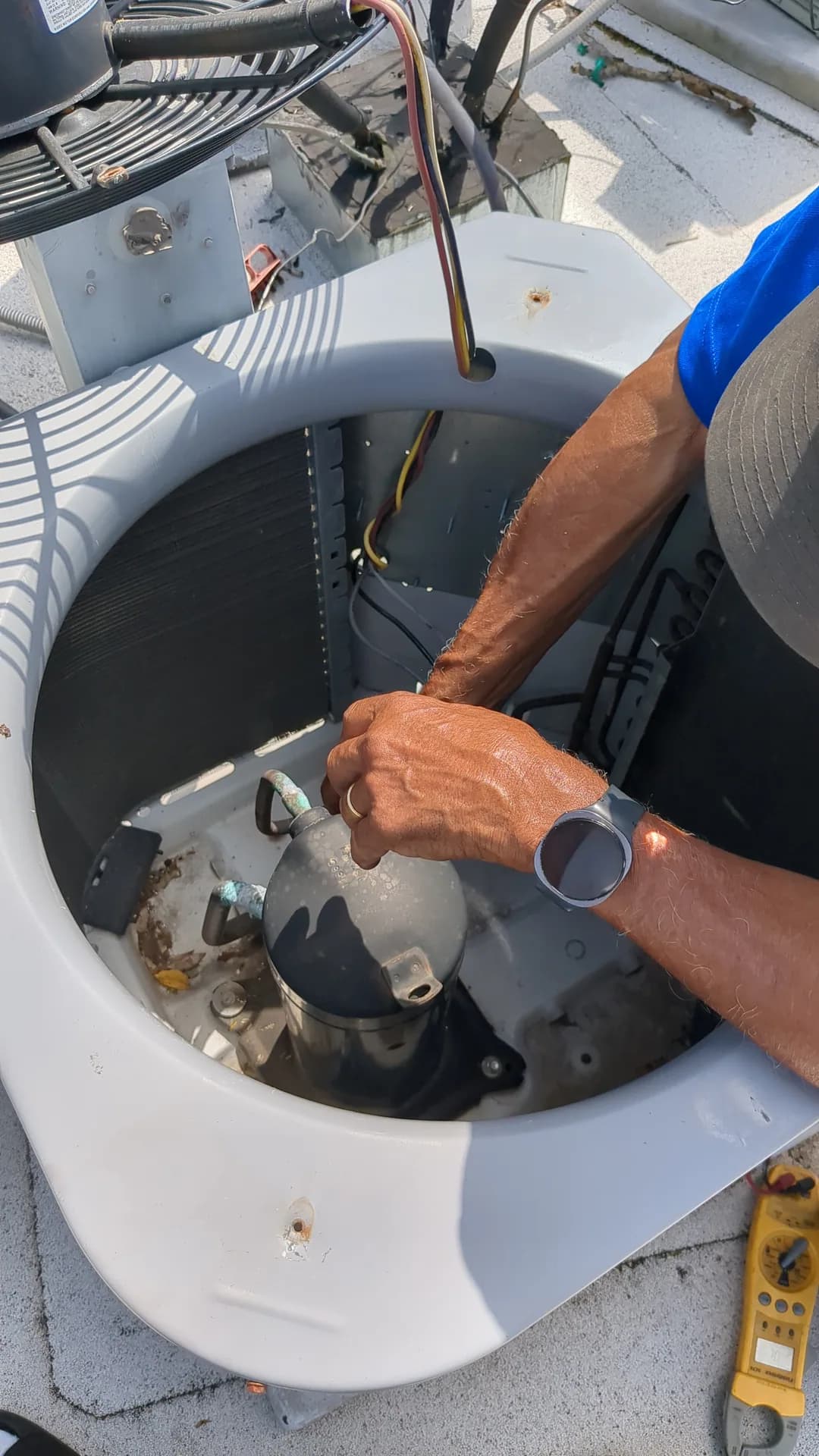
The compressor lives in the outdoor unit - that big metal box in your yard or on your roof. When you hear that outdoor unit kick on with a hum, that's the compressor motor starting up. It's the single most expensive component in your AC system.
The compressor takes low-pressure refrigerant gas from the indoor evaporator coil, compresses it into high-pressure gas (raising it's temperature), and pushes it to the outdoor condenser coil. This compression cycle is what makes cooling possible.
The compressor is a precision-built, hermetically-sealed pump with complex internal components. It's expensive to manufacture, expensive to install (requires refrigerant recovery, brazing, and vacuum procedures), and represents 60-70% of the outdoor unit's total cost.
These symptoms look like compressor failure, but 60% of the time it's a $ capacitor or contactor instead. Always test these cheaper components before replacing the compressor.
You hear a humming sound from the outdoor unit but the fan doesn't spin and the compressor doesn't kick on. This is usually a bad start capacitor ($ repair), not the compressor itself. Test the capacitor first.
AC tries to start but immediately trips the breaker. This can be a locked-up compressor drawing too many amps, but also check the contactor and capacitor first - much cheaper fixes.
Indoor unit runs but no cold air comes out. If the outdoor unit isn't running at all, the compressor might be seized. But also check for refrigerant leaks, capacitor failure, or electrical issues before condemning the compressor.
Outdoor unit struggles, stutters, or takes several tries to start. This is classic capacitor failure symptoms ($ fix). If it's actually compressor bearings wearing out, you'll also hear grinding noises.
We ALWAYS test the capacitor and contactor before diagnosing compressor failure. These components cost $ to replace versus $$$ for a compressor. It's the honest thing to do, and it saves you money 60% of the time.
Here's the truth most companies won't tell you: the symptoms of capacitor failure, contactor failure, and compressor failure look identical to homeowners. But the cost difference is massive.
Always test this first before diagnosing compressor failure.
Also test before compressor diagnosis. Easy to check.
Only diagnose after ruling out cheaper components.
If a technician quotes you a $$$ compressor replacement without testing the capacitor and contactor first, get a second opinion. These $ tests take 5 minutes and catch 60% of "compressor failure" diagnoses. Any honest tech tests these components first.
Let's be blunt: if your AC is 12+ years old and needs a $$$ compressor replacement, you should replace the whole AC system instead. Here's the math.
Total 5-year cost: $$$ (compressor + likely future repairs)
Total 5-year cost: $$$ (zero repairs, lower electric bills)
Replace compressor (check warranty first - parts might be covered)
Depends on your budget. Compressor replacement buys 3-5 years but you'll likely replace the AC within that timeframe anyway.
Replace the whole AC system. Spending $$$ on a compressor for a 12-year-old AC is throwing money away. Other components will fail soon, and you'll end up replacing it anyway.
Always replace with new R-410A system. R-22 compressors are scarce and expensive ($$$ just for parts). Not worth it.
If your AC is young enough that compressor replacement makes sense, here's exactly what the process involves:
We legally must recover all refrigerant from the system before opening it up. This takes 30-45 minutes. The refrigerant gets stored in our recovery tank and can be reused or recycled.
We cut the refrigerant lines going to the compressor (they're brazed/welded on, not just bolted). The old compressor is removed from the outdoor unit. Compressors weigh 30-80 pounds depending on tonnage.
New compressor gets mounted in place. We verify the replacement compressor matches the exact specs (tonnage, voltage, refrigerant type, connections). Any mismatch causes immediate failure.
We braze (high-temperature welding) the refrigerant lines to the new compressor using nitrogen flow to prevent oxidation. This creates leak-proof, permanent connections. Poor brazing = leaks = compressor failure.
We pull a deep vacuum on the entire refrigerant system for 30-60 minutes. This removes all moisture and air (both destroy compressors). We hold the vacuum to verify zero leaks before charging.
We add the exact refrigerant charge your system requires - measured by weight, not pressure. We verify proper subcooling and superheat readings to confirm the charge is perfect.
We run the system for 20-30 minutes, checking amp draw, temperatures, pressures, and airflow. We monitor for any unusual sounds or vibrations. Everything must be perfect before we leave.
Compressor replacement takes 4-6 hours for a straightforward residential job. Chicago alley access or rooftop installations can take longer (see below).
Chicago residential HVAC installations come with unique challenges that affect compressor replacement cost and complexity:
Most Chicago homes have outdoor units in narrow gangways or back alleys. Compressors weigh 30-80 lbs and must be carried through these tight spaces. This adds time and labor cost compared to suburban installations with wide side yards.
Impact: Add 30-60 minutes labor time, sometimes requiring two technicians instead of one.
Many Chicago multi-unit buildings and some single-family homes have AC units on the roof. Getting a 50-80 lb compressor up to the roof (and the old one down) requires crane rental for commercial buildings or multiple trips up narrow stairs for residential.
Impact: Rooftop compressor replacement costs $$ more due to access challenges. For commercial buildings requiring crane rental, add $$.
Chicago has thousands of pre-2010 AC units still running R-22 refrigerant. R-22 production was banned in 2020, making R-22 compressors scarce and expensive.
R-22 compressor cost: $$$ just for the part (vs $$ for R-410A). Total installed cost: $$$.
If your R-22 AC needs a compressor, replace the whole system with new R-410A equipment instead. The $$$ difference in price buys you a complete new AC with 10-year warranty instead of an expensive repair on aging equipment.
Most AC compressors come with a 10-year parts warranty from the manufacturer. But here's what almost nobody explains clearly: the warranty covers the compressor part, not the labor to replace it.
Most major brands include a 10-year parts warranty on the compressor. If it fails within 10 years, the manufacturer provides a free replacement compressor.
The warranty covers the compressor part but you still pay for labor, refrigerant, and other materials required for installation.
So even with a "free" warranty compressor, you still pay $$ for the replacement.
Manufacturer warranty claims require documentation, proof of installation, serial number verification, and sometimes diagnostics from the failed component. We handle all of this paperwork and deal with the manufacturer directly. You just pay us for labor and materials - we get the warranty compressor.
Here's exactly what compressor replacement costs in Chicago, broken down by component:
Compressor replacement on a 12-year-old AC: $$$ with maybe 3-5 years of life remaining and risk of other component failures.
New AC system: $$$ with 12-15 years of life, 10-year warranty, 30-40% better efficiency, and zero repair risk for a decade. The extra $$$ buys you peace of mind and a decade of reliable cooling.
$$$ total for R-410A systems (parts, labor, refrigerant). R-22 systems cost $$$ due to scarce expensive compressors. But if your AC is 12+ years old, spend the money on a new AC system instead - better long-term value.
If your AC is 0-10 years old, replace the compressor (check warranty first). If it's 12+ years old, replace the whole AC system. The $$$ extra cost buys you a complete new system with 10-year warranty instead of a $$$ repair on aging equipment that might fail elsewhere next year.
You can't tell without testing. The symptoms are identical - outdoor unit hums but doesn't start, struggles to turn on, or won't run at all. The capacitor costs $ to replace and fails more often than compressors. Always test the capacitor and contactor first ($ test). Any honest technician does this before diagnosing compressor failure.
4-6 hours for straightforward residential jobs. Chicago alley access adds 30-60 minutes. Rooftop installations take longer due to access challenges. We usually complete same-day if we have the compressor in stock or can get it from our supplier.
R-22 production was banned in 2020. Compressors for R-22 systems are scarce - only available from limited remaining stock. They cost $$$ just for the part (vs $$ for R-410A compressors). If your R-22 AC needs a compressor, replace the whole AC with a new R-410A system instead.
No. The manufacturer's 10-year parts warranty covers the compressor part itself, but you still pay for labor ($$), refrigerant ($$), and supplies ($). Total out-of-pocket even with warranty coverage: $$. We handle all warranty claim paperwork for you.
We'll test the capacitor first ($), check your warranty, and give you honest math on repair vs replace. No upselling - just the truth about what makes financial sense for your situation.